
BLOGWhy your ADHD gets worse before your period
(it's not in your head)
By Dr Pavitra Aran, Clinical Psychologist
Published 17 November, 2026

TL;DR:
ADHD can feel worse before your period as oestrogen drops. Hormones don’t cause ADHD, but they may change how loudly it shows up. Tracking your cycle for 2–3 months is the best way to spot your pattern. Armed with this knowledge you can plan for your hard weeks and give yourself compassion.
Some weeks you're on top of everything. Other weeks you can't find the right word, can't start the simplest task, and your medication feels like it's stopped working.
When women with ADHD describe this to me, one of the first things I'll gently explore is: where were you in your cycle?
There's usually a pause. Then: "Oh my gosh. Yes."
That's the aha moment. In my years as a psychologist, women with ADHD have rarely brought up hormones themselves. Most had no idea there could be a connection. But once it's pointed out, many start seeing the pattern everywhere: focus, motivation and memory dip in the days before their period, then lift again afterwards.
It's not a willpower problem, and you're not "just inconsistent". Part of what you're experiencing may be related to your hormones.
This post covers a little bit of the science behind it, why the connection is often hard to spot and some strategies to make it more manageable.
A note on language: we use “women” throughout because most of the research has been done with cisgender women. But this applies to anyone who has a menstrual cycle, including trans men and non-binary people.
How hormones affect ADHD
Dopamine is one of the key brain chemicals involved in ADHD. It plays a role in motivation, attention, working memory, planning and getting started on things.
Oestrogen interacts with the dopamine system. Put simply, when oestrogen is higher, dopamine tends to be better supported. When oestrogen falls, some women notice their ADHD symptoms get harder to manage.
Think of dopamine as fuel.
A neurotypical brain tends to wake up with fuel in the tank. They can just get started.
An ADHD brain often starts the day running low. And here's the cruel part: the things that top up dopamine, like exercise, take fuel to get started. So telling someone with ADHD to "just go for a run" is like saying, "Just drive to the petrol station and fill up." And they're saying, "I don't even have enough fuel to start the car."
Now add hormones. When oestrogen dips before a period, some women find their tank is running even lower than usual. Same car, same driver, less fuel.
Progesterone is part of the picture too. It can affect mood, anxiety, sleep and emotional regulation. The way these hormones interact is complex, and researchers are still working it out.
What it can look like across the month
The most common pattern we see is in the days before a period, when oestrogen drops. Then, after the period, as oestrogen rises again towards ovulation, many women notice their ADHD feels much more manageable.
Everyone is different, but this is what some women report:
ADHD often feels hardest when oestrogen falls before a period.
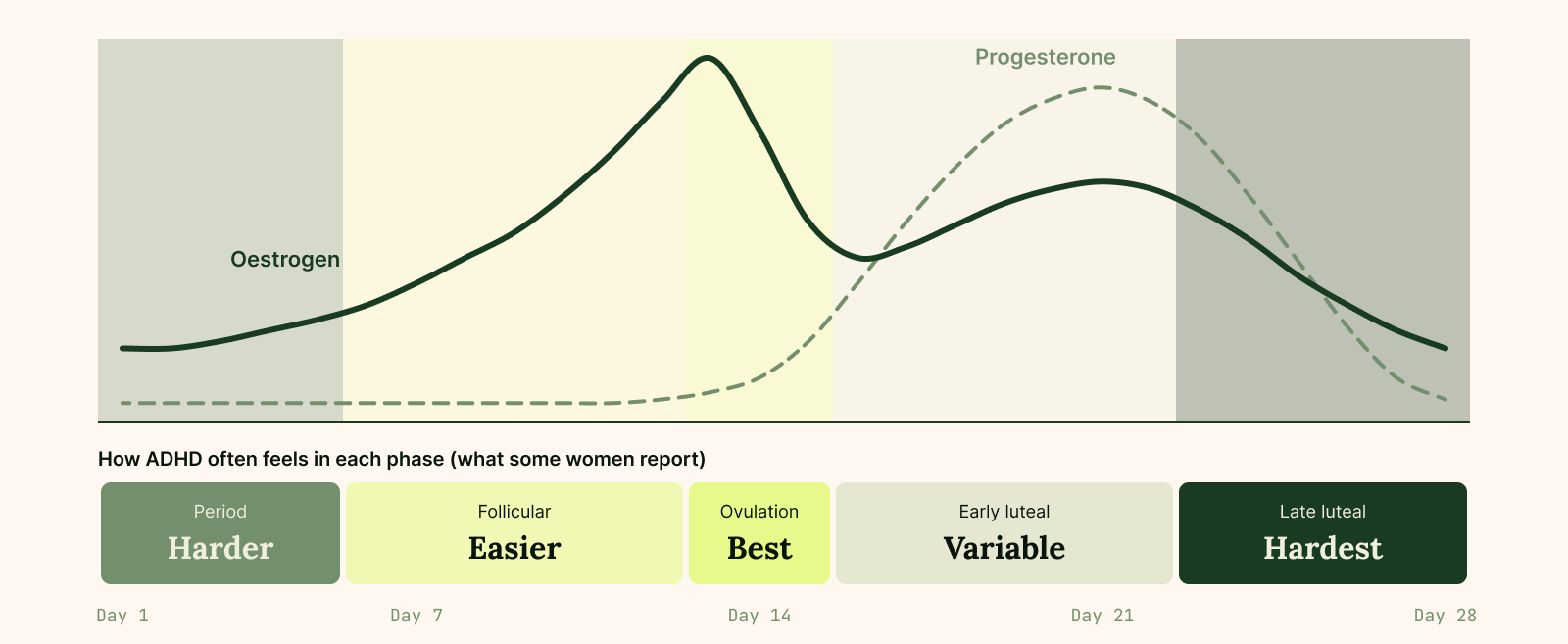
Illustrative 28-day cycle: ADHD pattern reflects what some women report, not every woman. (Osianlis et al. 2025; Kooij et al. 2025)
ADHD and PMDD: what's the link?
ADHD symptoms and mood symptoms are different things.
PMDD (premenstrual dysphoric disorder) is a more severe form of premenstrual symptoms. Mood changes such as low mood, irritability, anxiety and feeling overwhelmed build in the week or two before a period, then ease within a few days of it starting.
PMDD and cycle-related ADHD changes can happen at the same time, which makes them hard to tell apart. As a rough guide, PMDD mainly shows up as changes in mood, while ADHD changes tend to show up in executive function: starting tasks, remembering things and staying focused.
Research also suggests that PMDD may be more common in women with ADHD, particularly when the ADHD hasn't been diagnosed. Tracking the two separately, as described below, can help you and your health professionals see what's going on.
If you think you might have PMDD, talk to your GP. It's worth having it assessed in its own right, rather than assuming it's "just your ADHD".
Why it's so hard to spot: the ADHD paradox
If you ask an ADHDer, “How has your week been?” How was the past month?”. If you pay attention, you’ll see the cogs turning as they struggle to recall. Yes, ADHDers hate small talk… possibly due in part to their difficulty with recalling the past month let alone the previous day. That is because this recall requires working memory - a core difficulty of ADHD.
If you have ADHD, I wonder if you can relate?
Much easier is how the person feels at this moment. And often, that is how the individual will respond. If it’s a good day, they might just generalise the whole month to that feeling they have more ready access to. And if it’s a bad day, that can cloud their recall of a longer time period too.
This is one of the reasons, assessment and treatment of ADHD can be hard. Ask anyone who has gone through an ADHD assessment, where they are asked countless questions about their past and childhood, which is very hard to recall on the spot.
This is why I always encourage ADHDers to take notes into their assessments. This is the fix… Write it down. Then, we face the second hurdle of remembering where you wrote it down…
Clinicians can help you with this - be your external executive function, and log, to some degree, but between sessions, it really is up to you!
How to track your ADHD across your cycle
Use your phone notes, a notebook if you prefer analog, an app if you prefer digital (e.g. period tracking apps like Flo or Euki,), just make sure to have one location for it all.
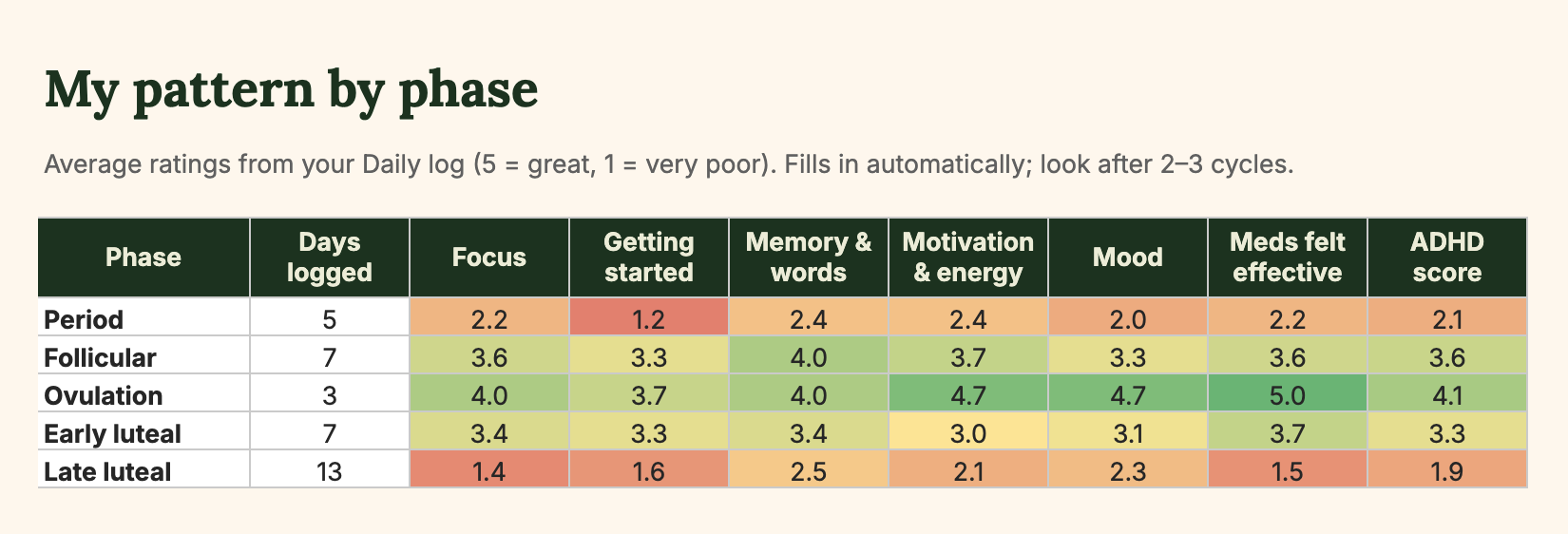
As an example, here is a free tracking template we created for you. More on how to use the tracker here →.
Rate each from 1 (very poor) to 5 (great):
Focus: could you stay on a task?
Getting started: how hard was it to begin things?
Memory and words: losing things, forgetting, word-finding trouble?
Mood and irritability: track this separately from the ADHD items
Sleep: roughly how many hours?
Medication: did it feel like it worked today? (if you take it)
Big demands: anything unusually stressful or important?
Do this for at least two or three cycles. One month can be a fluke. Several show a pattern. The more longitudinal data, the better. Always.
Bring it to your appointments. You're no longer relying on memory, and we can see the pattern together. For many women, seeing the trends visually is the moment it clicks: "My ADHD really does change."
Creating a habit is hard. Try habit stack, attaching it to something you already do daily - whether it is brushing or a coffee. Multiple phone reminders. And be kind to yourself when you snooze some of those reminders. Persistence though is key. Begin again.
Why ADHD medication can feel weaker before your period
"Doc, my medication no longer works!!"
This is one of the most common complaints I hear. Clients notice their medication doesn't seem to work the same way every day. They ask, "Am I on the right dose? Should I change it?"
A very common pattern is someone stopping their medication altogether during a bad patch. Then, a few months later, going back on it, after they experience some of the ADHD struggles they used to. to it, because they realise it was doing something after all.
For women especially, I will look at whether what is happening is to do with their hormonal shifts. The medication could still be working, only, they truly need a different dose because their ADHD varies across their cycle.
There is growing research here, finding women report their stimulant medication was less effective in the week before their period. With their prescribers, people are increasingly trialling a supervised dose adjustment for that premenstrual week, and we hear many reports of improvements. Of course, there are always individual differences and it may not apply to everyone, and requires close monitoring and guidance by the prescriber.
What this means for you:
If your medication feels inconsistent, track it alongside your cycle for a few months.
Bring that record to your prescriber. Showing them a pattern on paper will be more useful than trying to recall or state "it feels off sometimes" without the evidence of a pattern.
Please don't change your dose, or stop your medication, on your own. Any change should be made under the guidance and supervision of your prescriber and treating medical team.
How your hormones & ADHD change across your life
Hormones shift across a woman's whole life, not just across the month. Your ADHD might feel manageable in one season of life and much harder in another.
Puberty: ADHD may become more noticeable as hormones and demands significantly change. It's often put down to "being a teenager" or anxiety.
Pregnancy: Some women feel better, others find it harder. Sleep, physical health and medication changes all play a part. The brain is literally changing - matrescence!
Postpartum: Oestrogen and progesterone drop sharply after birth, alongside broken sleep and the huge mental load of a newborn.
Perimenopause: Oestrogen becomes more variable. Some women feel like their ADHD has suddenly got much worse. Some are diagnosed for the first time here.
If you're expecting a baby, it's worth preparing ahead not just for the birth or the baby, but maternal wellbeing over the postpartum period. The postpartum period including all the hormonal shifts and demands interacting with your ADHD is significant and this is where it is best to access as much external support as you can. Let others be your executive function.
The first two weeks especially with the hormonal changes are associated with increased executive dysfunction, exacerbated by sleep deprivation, and given ADHD’ers baseline executive dysfunction is already low, external support is invaluable. Planning for that in advance, with your partner, family and health team, is part of good ADHD care.
An honest caveat: research on ADHD and hormones has focused mostly on puberty and the menstrual cycle. Pregnancy, postpartum and especially menopause remain under-researched. We'll be writing about each of these stages in more detail.
What actually helps
First, I want to acknowledge something. A lot of ADHD advice asks you to plan, organise and build routines. Accessing a diagnosis requires these things, which no wonder so many adult ADHDers are diagnosed late. Being organised genuinely helps the ADHD brain. But planning and organising rely on executive function, which is exactly what makes ADHD hard. This is the conundrum. So if this feels difficult, that's not a personal failing. It's the irony of the condition.
With that in mind, and encouraging you to access a lot of self-compassion and patience, here's where I'd start.
1. Plan your big weeks around your cycle
Life is unpredictable, so this won't always work. But some demands you can see coming.
Once a month, look at the next four weeks: reviews, presentations, deadlines, travel, social events.
Mark where you're likely to be in your cycle for each one.
If a big day lands in a harder week, plan for it now: move it if you can, prep earlier, or line up extra support.
If you take medication and notice a pattern, raise it with your prescriber before that week, not during it.
2. Start with a tiny bit of fuel (dopamine)
Remember the fuel tank. Self-check. Are you empty? Try and access a dopamine enhanced with the least amount of friction.
Movement is a great dopamine enhancer but if you’re on empty, make it easy. Not a full workout perhaps, just any movement. Once you're going, the dopamine may help you keep going.
Walk for five minutes. If you keep going, great.
Access something you already do or enjoy. Enjoy riding your bike? Use it for your first commute
On harder weeks, lower the bar on purpose rather than skipping it entirely.
3. Get light in the morning
Early morning sunlight where possible.
Open the blinds as soon as you get up.
Have your coffee or breakfast outside, or by a window.
Choosing a room or desk? Pick the one with the most natural light.
4. Have a regulation tool ready
On harder days, emotions can run hot. Grounding brings you back to the present. Pick one to try this week:
Use your senses: name three things you can see, two you can touch, one you can smell.
Try a short guided meditation, if that feels doable.
Find mindfulness and being present difficult? Mind keeps wandering? Narrate out loud as you do it. For example, in the shower: "I'm picking up the soap. How does it smell? I'm turning the water warmer." Instead of daydreaming and losing 20 minutes, you're present, and more likely to get out on time.
5. Remember, remove the friction
The easier something is to start, the more likely it is to happen.
Download a meditation app now (I use Waking Up by Sam Harris), and put it on your home screen.
Set up your tracking reminder today, while you're thinking about it.
Leave your walking shoes by the door.
When to get support
The goal here isn't to turn normal hormonal changes into a problem. It's to understand how they might be affecting you.
It might be worth talking to someone if:
your focus, motivation or emotions seem to change a lot across the month
your medication feels inconsistent and you can't work out why
you're pregnant, recently had a baby, or in perimenopause and finding everything harder to manage
you've never been assessed for ADHD but this all sounds very familiar
At Still Moving, our psychologists work with adults with ADHD, including women navigating these hormonal transitions. We can help you track your patterns, build strategies for your harder weeks, and work alongside your GP or psychiatrist. Get in touch to find out more.
This article is presented solely for general informational, educational, and entertainment purposes. The use of information in this article is at the user’s own risk. It is not intended as a substitute for the advice of a physician, psychiatrist, psychologist, or other qualified professional, diagnosis, or treatment. Users should not disregard or delay in obtaining medical advice for any medical or mental health condition they may have and should seek the assistance of their healthcare professionals for any such conditions.
References
Osianlis, E., Thomas, E. H. X., Jenkins, L. M., & Gurvich, C. (2025). ADHD and sex hormones in females: A systematic review. Journal of Attention Disorders, 29(9), 706–723.
Kooij, J. J. S., de Jong, M., et al. (2025). Research advances and future directions in female ADHD: The lifelong interplay of hormonal fluctuations with mood, cognition, and disease. Frontiers in Global Women's Health, 6, 1613628.
de Jong, M., Wynchank, D. S. M. R., van Andel, E., Beekman, A. T. F., & Kooij, J. J. S. (2023). Female-specific pharmacotherapy in ADHD: Premenstrual adjustment of psychostimulant dosage. Frontiers in Psychiatry, 14, 1306194.